

Manual Shear Wrench
Your Professional Manual Shear Wrench Supplier!
Shandong Shengdingxin Precision Technology Co., Ltd. Isa professional fastening tool manufacturer in China with over 20 years experiences in this field. With profound technical expertise, rigorous quality control, and professional service, we have earned widespread recognition in the market and customers' trust. Our products include Electric Wrench, Hand Wrench, Rebar Processing Tools, Measuring Equipment Calibration,etc.
Why Choose Us
Wide Application
Our products are widely used in a variety of industries, including steel structure installation, equipment installation, power construction, metallurgical construction, bridge construction, railway construction, industrial plants, high-rise civil engineering, tower structures, and automotive assembly, demonstrating excellent adaptability and practicality.
Sales Market
Our products have been exported to countries and regions including India, the United States, Brazil, Pakistan, Nigeria, Bangladesh, Russia, Mexico, Japan, the Philippines, Ethiopia, Egypt, Vietnam, Germany, France, and Italy, covering a wide market and demonstrating strong international competitiveness.
Advanced Equipment
We have advanced production equipment, including high-precision CNC machine tools, automated production lines, and rigorous quality control equipment. This production equipment ensures that our products high precision, stability, and excellent durability.
Rich Experience
Our products have passed EU CE certification and multiple industry certifications, ensuring that the quality and performance of our products reach international advanced levels.
-
 Manual Tc Bolt Wrench for Steel ConstructionConstruction site: can be used to tighten the shear bolts, improve the construction efficiency.. Automobile maintenance: suitable for bolt operation of automobile engine, chassis and other parts..Add to Inquiry
 -
 Hand Twist Off Gun for TC Bolt1. Speciality: This tool is specially designed for TC bolts and can accurately control the tightening torque of the bolts to ensure that the bolts reach the predetermined preload.. 2. Efficiency: TheAdd to Inquiry


Specification
|
Model |
Max Torque |
Adaptble Bolts Dia |
Weight |
|
|
SDX-24HM |
1100N.m |
M20,M22,M24 |
3/4",7/8",1" |
2.4KG |
|
SDX-27HM |
1600N.m |
M24,M27 |
1",1-1/8" |
4KG |

Smart body design
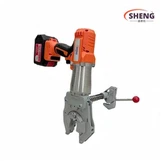
Extremely short working head, can be used in very tight locations, uses aluminum post, light weight and low labor intensity.
For extremely small spaces
The design of the product itself can more perfectly solve various narrow spaces for customers where other wrenches cannot be used.
High Working Efficiency
Adopts the principle of human mechanics, which greatly reduces the work intensity of workers, thereby improving work efficiency.
● Assembly and disassembly of different objects
● To tight hose clamps and fasteners in closed spaces
● Repetitive tight objects where speed is necessary

The most common application for manual shear wrenches is to create internal threading for fasteners. Fasteners like screws and bolts require internal threading. Fasteners themselves have external threading, but they still require internal threading during install. Manual shear wrenches offer a simple and effective way to create internal threading for fasteners.
Before installing a fastener into an object, a manual shear wrench May be used. Placing the end of a manual shear wrench into a pilot hole and twisting it from the handle will create internal threading. The tap at the end of the manual shear wrench will dig into the object while creating internal threading. Once the internal threading has been created, the manual shear wrench can be removed by turning the handle in the opposite direction.
The Most Effective Way to Use a Manual Shear Wrench
Choose the right manual shear wrench
Manual shear wrenches have adjustable manual shear wrenches or manual shear wrenches in various sizes that can be attached to the handle. You can use the same tool in various applications and fastener sizes. It’s crucial to pick the right manual shear wrench size to prevent harm and complete your task as quickly and efficiently as possible. Given that you won’t typically need to measure or estimate the size by sight, this is probably simpler than you may imagine.
Most manual shear wrenches have size indicators on them, or to see if it is a good fit, you can fit the manual shear wrench to the fastener before connecting it to the handle. If the manual shear wrench seems too tiny or too large on the fastener, try another size first. This step is crucial to prevent damage to your hardware. To prevent your fastener from getting trapped, start with a bigger size and work your way down.
Connect the manual shear wrench
Attach the manual shear wrench to the handle using a wrench with several removable manual shear wrenches. Once you’ve decided what size to use, lock the appropriate size in place if you’re using an adjustable manual shear wrench set.
Perform a quick and thorough inspection
It is advisable to check your manual shear wrench set before using it to ensure it is operating correctly. Hold the manual shear wrench firmly in place with one hand while turning the ratchet repeatedly from left to right with the other hand.
Attach the manual shear wrench to the fastener
Connect the manual shear wrench to the head of the fastener; the fit should be strong enough to allow you to adjust the ratchet whenever. Don’t rush this because it’s arguably the most crucial phase and demands precision.
Turn the fastener
It’s important to remember that tightening a fastener requires twisting the wrench handle in a clockwise direction while loosening a fastener requires moving the wrench handle in a counterclockwise direction. Spin the wrench handle where you want the nut or bolt to go. If you can achieve a solid grip, you can try moving the handle again and starting over to create more turns. You may even need to grasp the manual shear wrench to prevent it from rotating in the wrong direction because the tool needs resistance.
Continue turning until tight
Rotate the handle continuously until the fastener is entirely tight or loose. A button on some manual shear wrench sets makes removing the manual shear wrench from the fastener simple. Push the button to release the tool from the fastener once you’re done.
Shandong Shengdingxin Precision Technology Co., Ltd. Isa professional fastening tool manufacturer in China with over 20 years experiences in this field. We have evolved from a small startup enterprise into a leader in China's fastening tool industry. With profound technical expertise, rigorous quality control, and professional service, we have earned widespread recognition in the market and customers' trust.
Our factory is located in the Jinan city, Shandong Province, occupying a vast area and equipped with modern production workshops and advanced manufacturing equipment. We have a strict production management system within the factory to ensure that every product meets the highest quality standards. Additionally, we have a team of highly skilled and experienced production team who could promise our quality and provide professional tech support.
Our factory has different product lines, such as electric& battery rebar connecting wrenches, right-angle torque wrenches, electric torque& shear wrenches, manual torque & shear wrenches, torque multipliers, and torque wrench calibrators. These products could meet the needs of different industries and customers.



FAQ
We're well-known as one of the leading manual shear wrench manufacturers and suppliers in China. Welcome to buy high quality manual shear wrench made in China here from our factory. For price consultation, contact us.
manual shear wrench, hand twist off gun for tc bolt, manual tc bolt wrench for steel construction